

Single Page Applications
Fast, component-driven SPAs with route-level code splitting, lazy loading, and optimistic UI patterns for real-time data products.
We build React applications that scale, typed, tested, performant, and structured so large teams can move fast without architectural debt. From SPAs to design systems and micro-frontend architectures.
Fast, component-driven SPAs with route-level code splitting, lazy loading, and optimistic UI patterns for real-time data products.

Reusable component systems built with TypeScript, Storybook, and design tokens, shared across products and teams.

Choosing the right state approach per project: Zustand, Redux Toolkit, React Query, Context, or server state with SWR/TanStack Query.

Virtualised lists, memoisation strategy, bundle analysis, code splitting, and profiling with React DevTools to eliminate jank and unnecessary renders.
Clean data-fetching layers with typed API clients, error boundaries, loading skeletons, and resilient retry logic for unreliable services.
Module Federation and shell/remote patterns for teams that need independent deployments across large frontend codebases.
React's flexibility is both its strength and its pitfall. Without architectural decisions made early, large React codebases become spaghetti: deeply nested prop chains, uncontrolled re-renders, unmaintainable folder structures, and inconsistent data-fetching patterns.
We define architecture before writing features: folder structure, state ownership, API layer design, component composition patterns, and testing strategy. These decisions are documented so the team can maintain them independently.
Production patterns and experience depth: React expertise ›
React SPAs and micro-frontends ship with component libraries, state boundaries, and performance budgets on critical routes — often paired with a typed API layer when SEO requires a Next.js shell. Staging demos every two weeks include explicit rollback criteria and bundle-size diffs on main routes.
Dependencies, API contracts, compliance constraints, and performance budgets documented before sprint one.
Two-week increments with GitHub access, demo recordings, and QA checkpoints, client visibility at every stage.
Automated tests on critical paths, security review, runbooks, and knowledge transfer to your team.
Series B HR SaaS
B2B marketplace
Package
Ideal for
Investment
Includes
Package
Ideal for
Mid-market B2B
Investment
Includes
Package
Ideal for
SaaS & startups
Investment
Includes
Package
Ideal for
Regulated industries
Investment
Includes
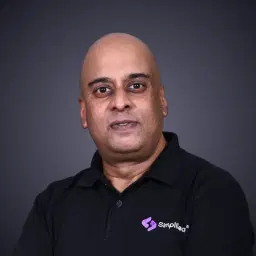

Company and Service positioning is reviewed for production delivery standards by Harsha Parthasarathy (Co-Founder, Strategy & Operations 24+ years IT veteran, IBM, Global Delivery, Program Management) and Keshav Sharma (Co-Founder, Engineering and Lead Architect, Full-stack engineering, product delivery and technical standards).
Simplileap Digital LLP
AAU-8582
DIPP83124Karnataka Startup
November 2020
Residency Rd, Bengaluru, India
Pure React SPAs make sense for authenticated dashboards, internal tools, and applications where SEO is not required and the full page is behind login. When you need server-side rendering, SEO, static generation, or edge performance, Next.js is the better choice. We recommend per project.
We use feature-based folder structure, barrel exports, domain separation, typed API layers, shared UI component libraries, and strict linting rules. Architecture decisions are documented so the codebase scales with your team rather than accumulating debt.
We profile before optimising, using React DevTools Profiler, Lighthouse, and production RUM. Common fixes we apply: memoisation of expensive computations, virtualisation for long lists, code splitting by route and feature, server state deduplication, and eliminating render cascades from poor context design.
Yes. We write unit tests with Vitest or Jest, integration tests with React Testing Library, and end-to-end tests with Playwright for critical journeys. Test strategy is defined in the architecture phase based on risk and velocity requirements.
Share your goals with our Bangalore team. We respond within one business day with a clear path from discovery to delivery.